| WA8LMF Home Page | Main Ham Radio Page | Main APRS Page | Updated 05 September 09 |
The vast majority of HF APRS operation in North America is conducted at the upper end of the 30-meter (10.1 MHz) band with 300 baud 200-hertz-shift "HF style" packet. The 30 meter band is open, around the clock, for long-range transmission (500-2000 miles/800-3200 Km or more) depending on time of day and solar activity.
Hams familiar with the fairly constant and predictable behavior of VHF and UHF are often bewildered by the seemly random behavior of long-range HF radio operation. Beyond-the-horizon HF transmission is made possible by reflection and refraction of radio signals by electrically-charged upper layers of the earth's atmosphere. These layers are ionized by the sun's radiation and by streams of charged particles (the "solar wind") reaching the earth from the sun. In turn, the amount of solar radiation varies (rather obviously) with the time of day and the time of year, and (less obviously) the position within a somewhat-variable approximately 11-year cycle of sunspot activity. Because the charged solar particles are partially deflected and steered by the earth's magnetic field, the level of ionization (and therefore HF propagation) varies with latitude. Further, the effect of a given amount of ionization affects various parts of the HF spectrum differently.
The result of this is that range and coverage on HF is ever-changing minute-to-minute, hour-to-hour, day-to-day and season-to-season. This behavior causes far less of a problem for APRS beaconing than for normal point-to-point communications with a specific station. Dozens of fixed stations are monitoring the 30M APRS channel simultaneously, 24/7. Propagation changes that make your path to a given receiving station fade really don't matter because you are probably being received by two or three more elsewhere. The 30 meter APRS infrastructure is really a world-wide diversity receiving system tied together by the Internet.
Click Here (Warning: 500K GIF image) for an animated demonstration of changes in 30 meter coverage over a 24 hour period.
Many stations around the North American continent (and in Europe) are silently monitoring this channel (i.e. no on-air beacons) and will gate transmissions heard into the APRS Internet system. You can easily get APRS position reports to findu.com, aprs.fi, and to individual Internet-connected APRS users from the remotest parts of North America and the surrounding oceans. (Even when there isn't any 2-meter infrastructure (digipeaters and igates) within hundreds of miles.) This is especially useful in the interior of Canada outside of the few major cities, and in the American west away from the populated coastal areas.
The capacity (throughput) of the 30M HF system is far, far lower than one is accustomed to on 2 meters.
The 30-meter APRS infrastructure is intended primarily to support mobiles operating in remote locations with no 2-meter coverage. Routine use by fixed stations for live station-to-station chat is discouraged. Because of the high error rate due to noise and/or signal fading on HF, the no ack/retry process used during APRS messaging frequently will result in 5 or 10 retries on every message transmission. These endless retries further reduce the already limited throughput of the single 300 baud channel.
| Keep in mind the first rule of packet: ALL of a packet must be received PERFECTLY before ANYTHING will be recovered from it. |
Transmitting long strings like messages radically reduces the chances of "getting through" successfully. The probability of a packet getting corrupted by a pop of noise, fading or another station transmitting on top of you increases rapidly with packet length. For the highest probability of success, transmit the shortest possible packets.
Because of unpredictable and constantly shifting propagation on HF, digipeaters are nearly useless and highly discouraged on HF. Consider that even one digipeat retransmission DOUBLES the time you occupy the channel on each transmission. There are enough monitoring stations, dispersed geographically around the United States and Canada, to virtually guarantee that your first hop transmission will be heard and gated into the APRS Internet system by at least one (and usually several) fixed stations, .
The very few digipeaters on HF respond to the path value "ECHO" rather than "RELAY" or "WIDEn-N" as on VHF. Placing "RELAY" or "WIDE" into an HF APRS path will absolutely guarantee that you WILL NOT be digipeated on HF. It will guarantee that your call will show up on Internet lists of clueless and ignorant users!
Some HF stations using dual-port TNCs (mostly Kantronics KAMs) can re-transmit what they hear on HF onto 2M where then (hopefully) a normal 2-meter igate will insert the packet into the APRS Internet system. The command to make this happen is "GATE" in the path. Thus you might use the path:
GATE,WIDE2-1
This would cause your packet to be retransmitted onto VHF and THEN get digipeated once on 2 meters. This can result in multiple reports entering the Internet system since an HF station may igate you directly off HF, and then later a second copy of the posit reaches the Internet after being retransmitted on 2 meters in one or more different locations, possibly hundreds or thousands of miles apart.
Note that long-delayed multiple copies of the same position report entering the APRS Internet System have, at times, caused mobile stations viewed on APRS maps to "hyper-jump" back and forth as more recent position reports get superseded by long-delayed older reports.
In the UIview program this would appear in the "Unproto address" field of "Setup, Station Setup" as:
APRS,GATE,WIDE2-1
Consider the implications of this through... You have no idea where you will be getting cross-gated from HF to 2 meters. You may get re-transmitted into numerous local VHF and UHF networks thousands of miles apart. Some people may find seeing "rare DX" on their Kenwood D700 front panels entertaining. Others may consider it out-of-area QRM.
Further, if you think you will try to get digipeated on HF, and then gate yourself onto VHF with a path like:
ECHO,GATE,WIDE2-1
think again! Since path commands are processed sequentially from left to right, you won't be gated unless you get digipeated first. Since the probability of a successful HF digipeat is very low, the probability of a successful cross-band gating is at least equally low. (This wouldn't prevent you from being igated directly from HF to the Internet; it just makes your packets needlessly longer, and therefore less likely to be decoded successfully by the igate station.)
| Unless you have some extraordinary
requirement, the best-and-most-likely-to-succeed path on HF is:
no path at all. Again, shorter is better on HF.
In the UIview program, you would enter only
APRS into the "Unproto address" field. |
Direct HF IGates provide connectivity everywhere
we didn't have in the past -- no need to digipeat or gate to VHF.
No digipeater use DOUBLES throughput on the channel.
Keep the path short; best is none at all, or
if you absolutely must, just "GATE"
No path shortens packets by 14 bytes!
This improves reliability of 40 character lines
by 20%!
Perhaps the most confusing issue for newcomers to HF APRS is the difference between the FM modulation mode they know on VHF, and the FSK or SSB modulation modes used on HF.
On VHF-FM, packet data transmission is done by rapidly
shifting an audio tone between two frequencies traditionally referred to
as the "MARK" and "SPACE" frequencies. These tones are inserted into an FM
radio's mic jack or equivalent. On 1200baud VHF packet, these two tones are 1000
Hz apart and standardized on 1200 and 2200 Hz.
On 300 baud HF, the actual RF carrier of the transmitter (essentially a continuous key-down CW transmission) is shifted between two frequencies 200 Hz apart at the 300 baud data rate. On thirty meters, these two frequencies, commonly referred to as "mark" and "space" are 10.149.200 and 10.149.400.
The traditional ham convention is to specify the actual RF frequencies of the tones. The commercial/military/regulatory convention is to specify the single frequency midway between the two RF frequencies, along with the shift. In this format, the 30M APRS channel would be quoted as:
"10.149.300 with +/- 100 Hz shift" or "200 Hz Shift Centered on 10.149.300" .
These two frequencies can be produced directly by some transceivers that have a dedicated FSK (frequency shift keying) mode that responds to RS-232 or TTL-level serial data provided to a dedicated port on the radio. However, it is far more common to create these RF frequencies by feeding alternating audio tones, 200 Hz apart, into the mic jack of an SSB transceiver.
Newcomers are often confused by the frequency relationships on SSB equipment compared to FM.
Since the net resulting RF signal frequencies are the sum (or difference) of the modulating audio tone frequencies and RF frequency, simply quoting the RF "dial frequency" for HF data modes is ABSOLUTELY MEANINGLESS unless you qualify it with the AUDIO tone freqs being used by the TNC or other device.
Since the actual transmitted RF frequencies are the indicated suppressed carrier frequency (i.e. "dial frequency") minus the audio tone frequencies (LSB) -or- the suppressed carrier frequency plus the audio tone frequencies (USB), the actual dial frequency you want WILL DEPEND ON THE SIDEBAND YOU CHOOSE (either one will work) --AND-- ON THE PARTICULAR AUDIO TONE FREQS your TNC or other device produces.
| IMPORTANT TO KNOW!!! Unlike 1200 baud VHF packet, there is no single standard for the audio tone frequencies used by various devices and software on 300 baud/200-Hz shift HF packet! As a result, the indicated RF frequency you set the radio to in order to produce a given actual RF frequency will depend on the audio tones produced by the particular device. |
| Device | Audio Tones Used |
| Kantronics KAM on HF, TNC2 (i.e. MFJ-127x, etc) on HF, TinyTrak III in 300 baud HF mode, paid version of AGW Packet Engine | 1600/1800 Hz |
| AEA/Timewave PK-232 | 2130/2230 Hz |
| Tigertronics TigerTrak In 300 baud HF Mode | 1100/1300 Hz |
| AGW Packet Engine Software (freeware version) | 2100/2300 Hz |
| AGW Packet Engine Software (paid version) | 2100/2300 or 1600/1800 |
| MixW Software in HF Packet 200 Hz
Shift Mode (Program can emulate a KISS TNC running at a wide variety of baud rates.) |
Tunable to anywhere within waterfall display, just as in PSK31. |
The differing AUDIO frequencies are really not a problem
on SSB, and are easily accommodated. Unlike FM, the audio frequency heard
at the receiving end is affected by the exact RF frequencies the
transmitter and/or receiver are set to. The audio frequency heard in the
receiver will change exactly Hz for Hz with changes in the RF frequency of the
tuning dial. You cause the the audio tone frequencies, as heard at the receiving
end, to be correct by tuning the transmitter to a slightly higher or lower
indicated "dial frequency" depending on the TNC device in use.
[This cuts both ways. If the transmitter is off frequency, the tones recovered
at the receiving end will be correspondingly off-frequency. Since the typical
TNC or soundcard softmodem (i.e. AGW Packet Engine or MixW in packet mode) will
ignore any audio tones that are more than about 20-30 Hz off the target
frequencies, frequency setting is --VERY-- critical and high frequency stability
is essential. You MUST be able to set the transmit frequency accurately to
within 10 Hz and KEEP IT THERE indefinitely. This is especially critical if
you are going to transmit "in the blind" without a signal to tune in on receive
first! (I.e. typical transmit-only mobile trackers that don't receive.)
Ideally you want a modern synthesized rig with an accurately calibrated TCXO
high-stabilty master oscillator. ]
The ONLY constants are the ACTUAL RF freqs of the 200-Hz-shift mark and space tones. . Again, on 30M APRS, they are:
Note that unlike classic RTTY with it's fixed sense of mark and space frequencies that require both parties to be using the same sideband, packet data is unaffected by sideband choice. Packet uses NRZI coding -- you can use either sideband and not worry about "being on the wrong sideband", or having to "invert" the sense of the received data.
To produce the correct RF frequencies with a KAM, TNC2, TinyTrak III (300 Baud HF mode) or paid version of AGWpe whose default audio tones are 1600/1800 Hz, you must set your radio to:
10.151.00 LSB
10.151.000 - 1.800 = 10.149.200
10.151.000 - 1.600 = 10.149.400
Or
10.147.60 USB
10.147.600 + 1.600 = 10.149.200
10.147.600 + 1.800 = 10.149.400
To produce the correct RF frequencies with a PK232 TNC whose default audio tones are 2110/2310 you must set your radio to:
10.151.51 LSB
10.151.510 - 2.310 = 10.149.200
10.151.510 - 2.110 = 10.149.400
Or
10.147.09 USB
10.147.090 + 2.110 = 10.149.200
10.147.090 + 2.310 = 10.149.400
To produce the correct RF frequencies with a TigerTrak whose 300 Baud/narrow shift audio tones are 1100/1300 (weird pairing -- but actually very nice because the tone pairs are in the dead center of the typical SSB transceiver's filter bandpass and suffer the absolutely least amount of phase and group delay distortion) you must set your radio to:
10.150.50 LSB
10.150.500 - 1.300 = 10.149.200
10.150.500 - 1.100 = 10.149.400
Or
10.148.10 USB
10.148.100 + 1.100 = 10.149.200
10.148.100 + 1.300 = 10.149.400
To produce the correct RF frequencies with the free version of the AGW Packet Engine softmodem, whose default audio tones on 300 baud HF are 2100/2300 you must set your radio to:
10.151.50 LSB
10.151.500 - 2.300 = 10.149.200
10.151.500 - 2.100 = 10.149.400
Or
10.147.00 USB
10.147.100 + 2.100 = 10.149.200
10.147.100 + 2.300 = 10.149.400
Note that technically, the LSB modes have the suppressed carrier outside the ham band. This is normally not a problem since the suppressed carrier frequency is NOT transmitted. The tone sidebands (which ARE transmitted) land well within the band.
Some HF radios with special "DATA" or "FSK" modes offset the indicated dial frequency to correct for the difference between the suppressed carrier freq and the actual mark frequency, typically assuming the lower tone is 2125 Hz (or sometimes 1800 Hz). This will force you to compute offsets different from what I have listed for LSB/USB. Or even (if you are lucky) just set the radio to an indicated 10.149.200 MHz.
| AGAIN: Quoting "dial frequency" alone on non-FM modes is ABSOLUTELY MEANINGLESS unless you qualify it with mode (USB/LSB/DATA, etc) and the AUDIO tone frequencies in question. |
Both the Byonics TinyTrak III and the Tigertronics TigerTrack TM-1 support 300 baud HF operation. The TinyTrak can encode the extremely short Mic-E packets. The TigerTrak produces short-form standard APRS posits, but not Mic-E. However the TigerTrak can store TEN different configurations (path, beacon rate, comment field, etc) .
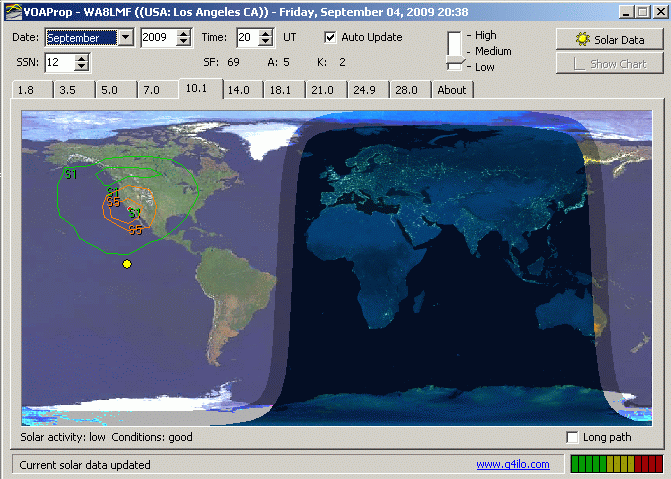
An invaluable tool for visualizing changes in ever-changing HF propagation in real time is the freeware VOAprop program from G4ILO. This program uses current solar activity data to estimate coverage on any of the HF bands (including 30 meters) from any point in the world, and displays it on a greyline world map. Go to:
http://www.g4ilo.com/voaprop.html
to download this great piece of freeware.
VOAprop showing actual coverage from my 30 meter igate in Los
Angeles.

30 meters is situated in a very optimal part of the HF spectrum for mobile operation. 30 combines the regional coverage of 75 and 40 meters with occasional long-haul "real DX" propagation like 20 meters. It is not plagued with the enormous signal levels of megawatt broadcast stations on 40, or with the numerous competition-grade "rock-crusher" DX and contest stations with huge antennas and 2KW amplifiers encountered on 20 meters. Further, you don't normally encounter the constant levels of crashing static and noise common on 40, 60 and 75 meters that requires serious power to overcome. As a result, extreme receiver selectivity and overload performance is just not necessary on 30M as it is on these other bands. Even very modest lower-cost transceivers work well on 30 meters.
30 meter HF mobile antennas represent less of a compromise than mobile antennas for lower HF bands, since the wavelength is shorter than on 160, 75 or 40 meters. Even a 6-foot long Hamstick can radiate an effective APRS beacon thousands of miles on 30 meters as long as it is mounted over a decent ground plane such as a car roof, trunk lid or the bed of a pickup truck.
Hamsticks have a small enough cross-section and low enough wind drag that it is practical to mount them using heavy-duty monster magnet mounts (the kind with single 8" diameter magnets or a cluster of three 6" magnets). You will still have to provide a solid ground connection to a car door bolt or trunk hinge bolt. The capacitive coupling to the body sheet metal through the bottom of the magnet that is adequate on VHF or even 11 meter CB just won't be enough at 30 meters -- you simply must make solid metallic contact with the car body near the base of the antenna.
A small HF rig like a Yaesu FT-857, Kenwood TS-50 or Icom 706 combined with a TigerTrak or TinyTrak, and a mag-mounted Hamstick can comprise an instant-mount HF tracker that can be deployed to any vehicle on short notice. The Yaesu and Icom rigs are preferred since they have the 6-pin mini-DIN "data" or "packet" jack that makes connecting an APRS tracker exceptionally easy, especially if you want to retain the mic hookup for voice operation.
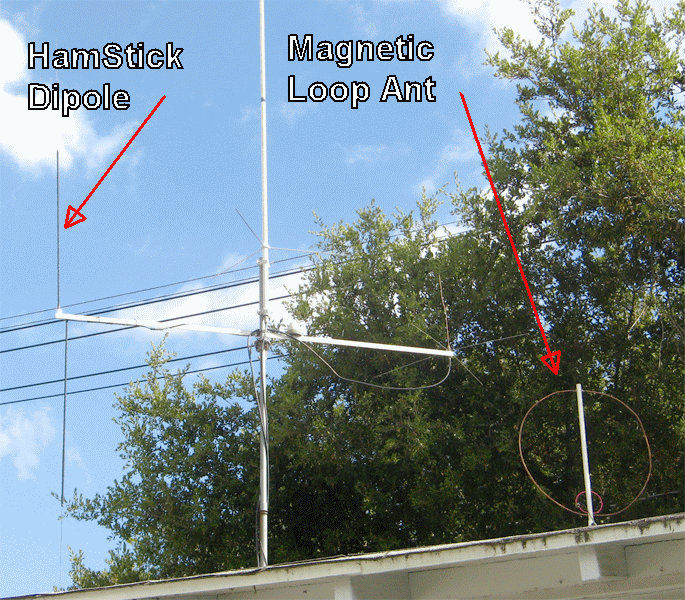
You can construct a compact but reasonably efficient fixed station antenna for 30 meters by building a dipole from two Hamsticks mounted back-to-back.
Although they are not rated or specified for 30 meters, the Yaesu ATAS-100 and ATAS-120 "mini-screwdriver" antennas will tune nicely on this band. These are perhaps the shortest lowest profile antennas available for HF APRS. These antennas, no taller than a 2-meter 5/8-wave, fit neatly on permanent mounts on the roof or rear deck of a car. Use an normal through-roof NMO mount and an NMO-to-UHF adapter to mount them. I have used one this way for 30 meter APRS with excellent results on cross-country trips throughout the interior west of the US and Canada.
Of course, just about any full-sized screwdriver, bug catcher or other continuously-tunable HF whip antenna can tune to 30M easily.
The AGW Packet Engine can emulate a dual-port TNC for HF-to-2M cross-band gating. Run it with a stereo sound card with one radio/soundcard interface connected to the left channel, and a second radio/interface on the right channel. You can configure the two channels to any combination of 300, 1200 or 9600 ports on the two sides. Note that this will normally require a sound system with a LINE level input since computer MIC inputs are almost universally single-channel.